Saturday, August 19, 2017

Trump, White Anger and the Paranoid Political Tradition

Just because you’re paranoid does not mean they’re not out to get you.

Maybe it's true:  immigration does exert a downward pressure on wages.  But maybe it's NOT TRUE.  Plenty of economists find that the incremental demand for goods and services created by immigrants -- and therefore economic growth -- more than offset the competition for wages.  These economists base their argument in evidence, not reason.  In fact, there is no correlation between cities with larger immigrant populations and lower wages.  And there is plenty of evidence to the contrary.

But it's certainly true that the argument is an authentic expression of fear and anger of working class whites.  They BELIEVE that immigrants are taking their jobs for lower pay, thereby driving wages down.  And they BELIEVE that the system is rigged against them because to them it's self-evident:  low wages are good for employers, good for business, good for the establishment.  And whether they're true or not, these beliefs have an effect on our politics, our government and our history.

This essay by Lynn Vavreck in the New York Times is a classic summary of this dilemma and it's impact not only on electoral politics and public policy but also how we think of ourselves.

Saturday, August 12, 2017

Artificial Intelligence is Out of Control at Facebook

Has anyone else been following this thread of alarmist articles in the media?  Facebook deployed some "virtual assistant" technology or "bots" that apparently developed their own "language" to communicate between themselves more effectively.  Oh no!  Next they'll be conspiring against us!

From Dave Gershgorn at Quartz:
Recent headlines and news articles have depicted research from Facebook’s artificial intelligence lab as the sci-fi beginnings of killer AI: one bot is learning to talk to another bot in a secret language so complex that it had to shut down. A BGR headline reads “Facebook engineers panic, pull plug on AI after bots develop their own language,” and Digital Journal claims in its article that “There’s not yet enough evidence to determine whether they present a threat that could enable machines to overrule their operators.” 
Most of the coverage has been ridiculous:  not just a waste of time or useless but actually misleading.  These writers and publishers are using words to amuse, alarm and provoke but not to explain.  Classic mystification.

But Dave does a decent job here, explaining that, in fact, there is nothing nefarious going on:
The bots did exactly what they were programmed to do: haggle over fake objects. They developed a new way of communicating with each other, because computers don’t speak English—just like we use x to stand in for a number in math, the bots were using other letters to stand in for longer words and ideas, like “iii” for “want” or “orange.”

Saturday, December 31, 2016

Media, Corporations and Democracy

Robert Reich has posted another excellent video, this one entitled "Trump and the Media." In it he outlines how Trump is using power, the law and public opinion to undermine the media and consolidate his own power. Many of my friends and colleagues have responded to this thoughtful analysis with a big "So what?!" They point out that the media has always been biased, that it's never been truly independent, that it's all owned by a couple of corporations and none of them can be trusted. So what's the big deal?

This is fallacious reasoning for three reasons.  First, no matter how bad the media gets, it doesn't make it any more or less important for our communities, our society and our Republic. And second, just because they are biased, not independent and privately owned, does not mean that they MUST be undeserving of our trust. And finally, by generalizing and giving up, we may actually be making matters worse for the few remaining journalists, editors and publishers out there who are still fulfilling their public mission. Cynicism about the media is not the same as skepticism.

Wednesday, December 28, 2016

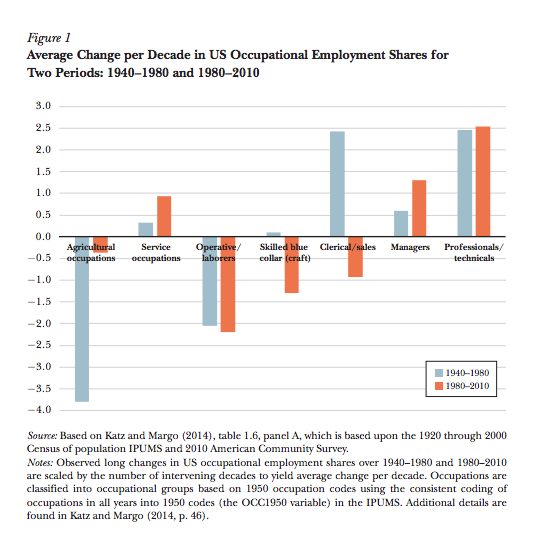
Automation and the Future of Work

My mother sent me this TedX video of David Autor, an MIT Professor of Economics.  It's great.  I highly recommend it. Here is his paper on the subject offering even more detail.  

The impact of technology is all around us and just seems to accelerate leaving entire generations in lower-paid, less skilled jobs than they had only 30 years ago.  This chart clearly shows waves of losses and gains in US employment by sector between 1940 and 2010.

Saturday, December 24, 2016

More on the Facebook Fake News Story

Finally we have John Herrman's post from the Times that gets to the root of the "Fake News" story.   He gets it right and summarizes it better than I did in this previous post.  There are really three problems, the first of which is simply the nature of the World Wide Web and the Internet, which, like any truly global market, is practically unregulated in important ways.  Not much we can do about fake news here.  The second problem is user-generated content published on Facebook which are and will remain un-curated, the responsibility of Facebook users, much of it populated with ridiculous and unsubstantiated opinion and outright lies.  It'll be impossible for Facebook to be the arbiter of truth in this domain either.

Sunday, November 13, 2016

The Role of Facebook and Social Media in the Election of 2016 (edited)


This much is true:  "The post falsely claiming that the Pope endorsed Trump has more than 868,000 Facebook shares, while the story debunking it has 33,000.” And it may have had a significant effect in Trump's triumph, claims Cliff Kuang in this FastCoDesign post.  He's mistaken, however, when he asserts that this problem is a design flaw in Facebook specifically or social media in general.  Blaming Facebook for the impact of fake news on society is like blaming the effect of gossip transmitted via post or ATT on the post office or the phone company.  Unless, of course, we consider the scale of "sharing" afforded by social media...

Modern web and mobile experiences make it easier than ever to create and consume social content... but it makes it harder and harder to understand relationships between sources of information and virtually impossible to easily confirm the source and integrity of more and more content on the Internet.  While this is true in general, he's got it wrong in this case:  this is not really a Facebook or a Facebook design problem.  He's not thinking clearly about who actually creates social media and why.  If we understand more about what the web is, what Facebook is, who owns what and who pays for it all, it's pretty clear that everything functions rather well at least with respect to its design intent.  It's just that neither the web nor social media is actually DESIGNED to deliver reliable and verifiable content.  This is a publishing problem which happens to include design, not a design problem per se and certainly not a technology problem. (1)

Saturday, September 24, 2016

Reflections on the Passing of John Rassias

I got the email from Professor Nancy Vickers:  John was gone.  Deep breath…

So what was I to make of that, I wondered?  All that motion, but to what end?  Boundless passion, for sure.  So much heart.  Love.  But was there progress?  Or just a lot of heat?  The older I get the more I want to know: what was that all about?  What have we learned?

Sunday, August 21, 2016

Race, Segregation, and Stories About Faceless Institutions, Families with Faces AND Evidence

I just finished reading this article in the Times today about a "broad yet little explored fact of American segregation.  I like that:  the FACT of segregation.  And the story of how even "affluent black families, freed from the restrictions of low income, often end up living in poor and segregated communities anyway."  I liked it a lot.  I learned something new about how laws and courts and the best of intentions of lots of people are simply not enough to change behaviors -- complex behaviors of almost ALL of us -- that perpetuate decades of segregation that disproportionately disadvantage another generation of Black Americans.  Sadly it IS still about race:  not class, not culture, not resources, but RACE.  The evidence is pretty clear.

I reflected for a minute and learned something else:  it is possible to tell a good story about complex systems and evidence that is also about individuals.

Saturday, March 19, 2016

On Generalizing and Stereotyping Illiberal Liberals

Of course the main point of this article in the Chronicle of Higher Education is really about the illiberal intellectual climate in higher ed.  It's probably a pretty legitimate critique of the academy which, like everywhere else in our society, has been politicized and has become rather polarized.  In talking with our academic friends, it seems horribly stifling, actually, in dire need of reform.  It is really difficult to criticize many of the taboos, especially those which are racially charged, without being perceived as a bigot yourself, which is another legitimate point of the article.  

On the other hand, taking a broader view of history, we should probably admit that, while it might be hard to bring into question such taboos in academia at the moment, it is not impossible.  The cult of "political correctness" is not operating with equal force all disciplines and all schools.  But what really bothers me is that Boyers projects his complaints of American higher education to American society as a whole.  It seems to me a bit exaggerated to claim that "life of ideas is also increasingly compromised in precincts beyond the academy."  On the contrary, at the moment we're witnessing a very public moment where it's not only permissible to reject these taboos of political correctness, but it's also popular to deliberately single out and offend entire groups of people, even to the point of inciting violence, all in the name of being against "political correctness."  Isn't that evidence that the power of the so-called "liberal elite" -- which presumably controls American universities from coast to coast -- is not quite as absolute as Boyers claims?

Monday, June 30, 2014

Automation, Labor and Capital

Here is a new thesis on the old relationship between Labor and Capital:  technology is causing them to fuse.  Do you buy it?

Erik Brynjolfsson et. al. have written in Foreign Affairs:
Machines are substituting for more types of human labor than ever before. As they replicate themselves, they are also creating more capital. This means that the real winners of the future will not be the providers of cheap labor or the owners of ordinary capital, both of whom will be increasingly squeezed by automation. Fortune will instead favor a third group: those who can innovate and create new products, services, and business models.

Sunday, March 02, 2014

A Journalist Asks "How Do We Know?"

I just posted another essay on journalism, bias, evidence and the problems confronting readers, editors, journalists and publishers alike.  How do we actually know what happens?

Friday, January 03, 2014

Respect for Journalists and Historians: Knowing What Happened is Hard


So I kind of want to post this on my science site because this is really about evidence again and "how do we know."  On the other hand, in this case it's about Benghazi, and if I write about it at all, it's probably a good idea to keep it separate from my views on science and society, even if some of the philosophical elements are the same...

Yes, Benghazi.  I have already spent an hour on this article from the Sunday Times called A Deadly Mix in Benghazi by David Kirkpatrick.  It's hard.  I'm still reading it.  I recommend it, though.  

I decided to read it because right off the bat it's focused on what actually happened rather than the spin in Washington.
Months of investigation by The New York Times, centered on extensive interviews with Libyans in Benghazi who had direct knowledge of the attack there and its context, turned up no evidence that Al Qaeda or other international terrorist groups had any role in the assault. The attack was led, instead, by fighters who had benefited directly from NATO’s extensive air power and logistics support during the uprising against Colonel Qaddafi. And contrary to claims by some members of Congress, it was fueled in large part by anger at an American-made video denigrating Islam.

Monday, December 30, 2013

Rehosting Posts from our Italy 04 Experience Here

I'm in the process of moving all of the content from our Italy 04 website here at Blogger.

It's interesting to reexamine old posts.  Here is a great one by Sarah on her impressions of 'Social Life in Siena.'  Pretty amazing insights, especially considering that it was TEN YEARS AGO!